
Angular, Succedent and Cadent Houses
The twelve houses of the birth chart are divided into four quadrants, and each quadrant has three houses with different functions: one that initiates, one that sustains and one that adapts. This gives us the three groups of houses: angular, succedent and cadent.
The way they work can be compared to the modalities of the zodiac: cardinal, fixed, mutable. In the natural wheel, the angular houses coincide with the cardinal signs (Aries, Cancer, Libra, Capricorn), the succedent houses with the fixed signs (Taurus, Leo, Scorpio, Aquarius) and the cadent houses with the mutable signs (Gemini, Virgo, Sagittarius, Pisces). One classifies signs and the other classifies house positions, but they share the same logic.
Angular Houses: 1, 4, 7 and 10
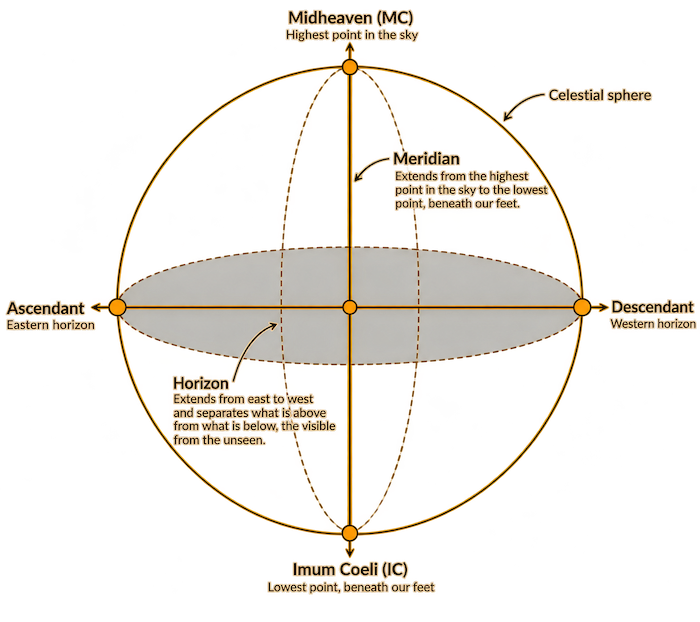
The angular houses are houses 1, 4, 7 and 10, associated with the four fundamental angles of the chart: the Ascendant, the IC, the Descendant and the Midheaven. They are the houses where each quadrant begins, the ones traditionally considered the most active, the most visible.
Together they form the cross of the chart. One axis is the horizon, which separates what is above from what is below. The other is the meridian, which joins the highest point of the sky with the deepest.
In the angular houses something begins: in the 1st house, presence in the world; in the 4th, rootedness; in the 7th, the encounter with the other; in the 10th, the place one occupies in full view of everyone.
Succedent Houses: 2, 5, 8 and 11
In Hellenistic astrology they were called epanaphora, because they are the houses that follow the angular ones.
If we read each quadrant as a sequence, the succedent houses consolidate what the angular houses initiated. What the 1st house puts into the world, the 2nd house makes stable. What the 4th roots, the 5th expresses. What the 7th binds, the 8th makes deep and shared. What the 10th structures, the 11th opens up to wider networks.
Cadent Houses: 3, 6, 9 and 12
The name comes from the Latin cadere, to fall: these are the houses that decline or move away from the angles, which in Greek were called apoklima. Tradition considered them weaker, and some of them, like the 6th and the 12th, difficult.
In that same sequential reading, the cadent houses process what the quadrant consolidated and prepare the way into the next quadrant. The 3rd house circulates what is immediate before the rootedness of the 4th. The 6th refines the everyday before the encounter of the 7th. The 9th seeks meaning before the structure of the 10th. The 12th dissolves what has no form before the 1st begins again.
The Three Crosses
Considered by sign, the houses within the same group relate to each other like the signs of the same modality: each one forms two squares and one opposition with the other three. That’s why we speak of three crosses: the angular, the succedent and the cadent.
This has a consequence worth looking at. The square, the aspect with the worst reputation, doesn’t only appear between planets: it’s in the very structure of the chart, in the way the houses are organized. The angular houses are square to one another, and nobody reads that as a flaw in the chart, but as the cross that gives it shape.