
There is a crack in everything, that’s how the light gets in,” sang Leonard Cohen. But before Cohen, before the light, before all of that, there was the void. And from the void, the Greeks—those wine-drinking philosophers who lived for these questions—tell us that Chaos was born. And right after, without asking for permission, Eros appeared.
Not the chubby, mischievous baby on Valentine’s cards—no. Eros as a primordial force. Eros as the verb before the noun. Pure, abstract, cosmic desire, the gravitational pull that made the fragments of the universe collide and create stars, planets, and eventually, us—idiotic heirs to all that power, trying to shrink the divine down to a like on Instagram.
And that’s it, right? That’s what we’ve done with “love at first sight.” We’ve packaged it, given it an 80s synth-pop soundtrack, and sold it as the premise of a romantic comedy. You see someone across the room, the light hits them in a particular way, a chord sounds, and boom. It’s a nice moment. It’s exciting. It’s joyful. It is, above all, safe. Because in our version, “love at first sight” is an aesthetic event. It’s about admiration. About “wow, I like you.” It’s the tip of the iceberg, polished and shiny, without the ice monster hiding beneath, waiting to shatter the ship of your orderly life.
And we cling to that sanitized version because the world is chaotic enough. Because we have deadlines, mortgages, a climate crisis, and the ghost of an economic recession lurking. Who the hell wants to invite a primordial god into their two-bedroom apartment with damp problems? We domesticated it, turned it into a consumer product. We throw it into the blender of late capitalism with everything else and out comes “love bombing,” “situationships,” and the tyranny of the demand to be happy, to have a perfect, optimized connection, as if love were an app that can be updated to fix bugs. We’ve become so addicted to safety that we confuse love with comfort, and the person who splits us in two with a “red flag.” We’ve medicalized the sacred melancholy of Eros and called it “attachment anxiety.” We’ve put a price on the wound and decided it’s not worth it.
But the Greeks, those brilliant, depressed sons of bitches, weren’t content with the tip of the iceberg. They wanted to descend into the depths, even if the icy water stole their breath. For them, Eros wasn’t the tip. He was the entire monster. And their “love at first sight” wasn’t a like. It was a lack.
Imagine it. It’s not that you saw Psyche and thought, “wow, what nice cheekbones.” It’s that you saw her and felt the air escape your lungs. That a part of your soul you never knew was missing—that you’d lived your whole life without it, calm, ignorant—suddenly screamed that it was there, in that other body, and that you had to get it back or die trying. It’s not admiration. It’s recognition. It’s yearning. It’s a lack so visceral it feels like an illness. And it is. The poets described it with the symptoms of a fever: palpitations, insomnia, loss of appetite, an obsession that eats you alive from the inside. It is a sacred affliction because it elevates you to a state of ecstasy while simultaneously destroying the foundations of who you were. It is a temporary psychosis induced by the gods.
The Greeks even had a word for the sickness of love: limeros. It wasn’t a metaphor. It was a diagnosis. A state of languor and fever in which the lover could only think of the object of their desire, literally consuming themselves. Poetry is full of pale, emaciated heroes and heroines lying in their beds because the image of the other has taken hold of their humors, unbalancing their body as much as their mind. It’s the same energy that today makes us check our phones obsessively, interpret every “last seen,” every “read receipt” as a divine omen. Technology hasn’t changed the symptom, it’s just given it a new interface. Limeros now has 5G. It’s the same open wound, the same “I lack” screaming from the gut, only now the scream is drowned in a WhatsApp group or in Instagram stories, that modern pantheon of false gods where we all act as if our lives aren’t bleeding out inside.
And therein lies the first great difference. Our “love at first sight” is ours. We generate it ourselves. Our hormones, our preferences, our baggage. It’s an internal, personal, almost psychological event. But Eros… Eros is external. Eros is an act of divine violence. It is the arrow of a blind and capricious archer that hits you in the chest when you least expect it. You didn’t choose it. You didn’t see it coming. It had nothing to do with your physical type or your checklist of requirements. It strikes you from the outside, like lightning, and turns you into an instrument, a channel for an energy that is far greater than you. That’s why it hurts so much. Because it’s not yours. It’s using you. It possesses you.
That’s the key word: possession. Not in the sense of “you are mine,” which is more from Mars, from conquest. But in the sense of being possessed. Like an exorcism in reverse. It is divinity forcing its way in. And for a few moments… you cease to be you. You cease to be your ego, your carefully constructed personality, your insecurities, your history. You become a pure vehicle for primordial desire. You become a god because you are being pierced by the same force the gods used to create the world. It is terrifying. It is addictive. It is, probably, the closest a human can get to enlightenment without dying in the process.
It is the only kind of possession we long for and fear. The one that liberates us from ourselves. For an instant, your character—that careful construction of childhood traumas, social expectations, and defense mechanisms—shuts down. And what remains is pure instinct, pure spiritual animal. This is why love like this hurts: because it is a kind of death. The death of the self you believed you were. And no one likes to die, even if what comes after is a vaster, more terrifying form of freedom. It is the ecstasy of the club at 3 a.m., when the music pierces through you and you are no longer the one dancing, but the dance itself. It is the conversation that lasts all night, where you are not trying to impress, but words flow through you from a place you never knew existed. Eros is that DJ who plays the track that unravels your sanity. It is the set and setting for your own personal destruction ceremony.
And that is why it is so ambivalent. Our modern version is pure joy, pure excitement. Eros’s version is ecstasy and anguish fused into one. It is the sweet agony. It is the melancholy of knowing you have tasted the nectar of the gods but must return to live in the world of men. It is the obsession that won’t let you sleep, that makes you listen to a song on repeat for hours because it reminds you of their perfume, that makes you type a message and delete it three times. It is glorious and it is miserable. It is the wound you don’t want to heal because the pain is the only proof you have left that it was real.
The Greeks understood it as destiny intervening. Cupid doesn’t shoot his arrows randomly at a village fair. He is the executing arm of a greater cosmic plan. He is the way the gods move the pieces on the board, to ensure that one mortal joins another to give birth to a hero, or to start a war, or to simply remind us that we have no control over anything, especially our own lives. Modern “love at first sight” is a fortunate accident. Eros is a sentence.
But the human soul, eternally hungry for maps for its own chaos, needed to chart even this untamable god. It wasn’t enough to feel it; it had to be named, given coordinates for the ecstasy. And so, in the frenzy of the 20th century, astrology, sifted through the stardust and found a pebble with a potent name: the asteroid Eros.
Not a slow planet dictating generations, but a rock. Something intimate, personal, a cosmic bullet wound. It makes sense, doesn’t it? Something so piercing, so specific as the quality of our most visceral desire, couldn’t be a gas giant. It had to be this: a wandering fragment, a desperate romantic note written on the wall of your natal chart. It became popular because we needed a word for what Venus could not name. Venus is harmony, beauty, pleasure. Eros is the dark verb that comes before. Venus makes you want a rose; Eros makes you bleed for it.
And there it is, it has always been, in your chart. Not as a planet, but as a point, a coordinate of extreme sensitivity. A place on the map that, when activated—whether by the slow transit of a god like Pluto or by another human’s natal Sun—sounds an alarm in the center of your chest. It is the universe making that notification sound you cannot ignore. It is the arrow.
The sign Eros falls in is the disguise your downfall will wear, the aesthetic of your ecstasy:
- Eros in Scorpio will need the poison of intensity, the shared secret, the promise of a fusion that erases all boundaries.
- Eros in Gemini will need the perfect word, the joke only the two of you understand, the mind that never stops stimulating you, the torture of a conversation that must never end.
But to understand the why of this mechanics of darkness and revelation, we must tell the story. The real one.
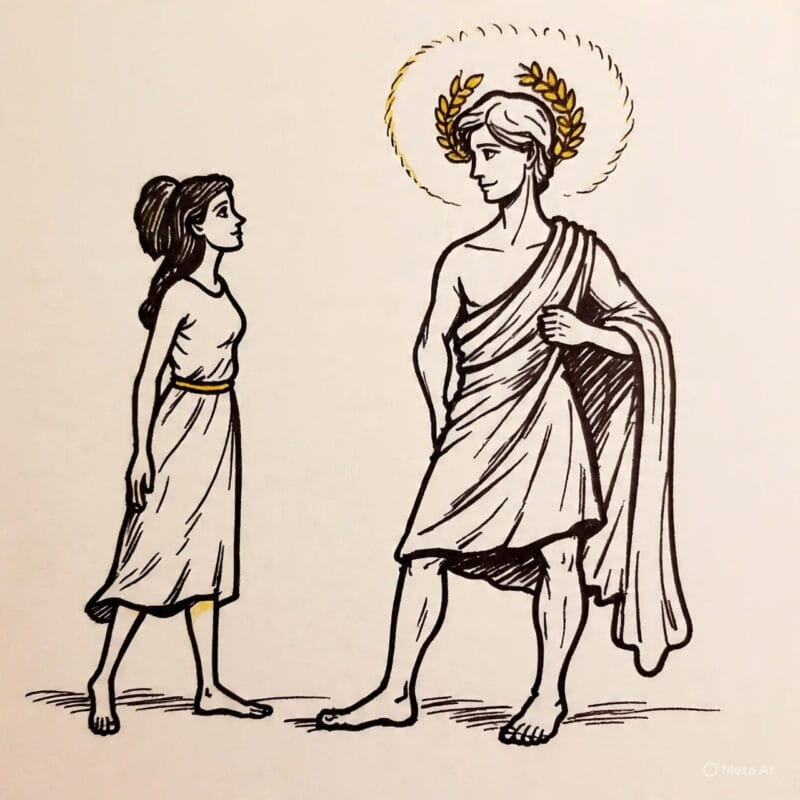
Psyche was a mortal of such disturbing beauty that men began to worship her instead of Aphrodite. The goddess of love, enraged by this usurpation, sent her son Eros to strike her with passion for the most vile and grotesque man he could find. But here is the first twist: Eros, upon seeing her, shot himself. The arrow of desire pierced his own chest and the god who provoked love in others fell helplessly in love with a mortal.
Eros, wounded and vulnerable, did not take her by force. He kidnapped her with a sweet trick. A whisper from the oracle told her parents to prepare her for marriage to a monstrous serpent. They took her to a mountain top and abandoned her to her fate. But the wind Zephyr gently carried her away and deposited her in an invisible palace, a place of wonders where the servants were voices without bodies and where, every night, in absolute darkness, her lover came to her bed. It was Eros. But she did not know. The rule was clear, the primordial pact: she could enjoy all the pleasures, all the wealth, all the tactile and ardent love he could give her… but she could never light a lamp to see his face. Love could only flourish in darkness, in mystery, in surrender to pure feeling without the mediation of eyes, reason, certainty.
Psyche, like us, failed. Incited by her jealous sisters (who are like the voice of anxiety and insecurity within us), who told her he might indeed be a monster, she lit a lamp one night to see him. And she saw him. Not a monster, but the most beautiful divinity ever created, lying beside her. But in her trembling, a drop of hot oil from the lamp fell onto Eros’s shoulder. The god awoke, felt the betrayal, the breaking of the pact of blind faith, and vanished. The palace disappeared. Psyche was left alone, pregnant with their daughter (Voluptas, Pleasure), in a desolate wasteland. Illuminating Eros with the light of reason—wanting to possess, understand, secure him—was to destroy him. She lost him.
And then the trials began. Aphrodite, still furious, captured Psyche and imposed a series of impossible tasks: separate a mountain of grains, retrieve the golden fleece from rams so wild they destroyed any man with their bronze horns, fetch water from the river Styx… Each trial was a metaphor for individuation: learning patience, taming the brute forces of nature, approaching death. Psyche, the soul, could not do it alone. She needed help (from ants, a reed, an eagle). But the crucial thing is that she passed them. She grew stronger. She ceased to be the vulnerable princess abandoned on a mountain and became a heroine in her own right.
In the end, her transformation was so profound that the gods themselves pleaded for her. Zeus offered her ambrosia, made her immortal. And so, Psyche was able to reunite with Eros, but this time not as his clandestine mortal lover, but as his equal, as a goddess.
And that is the uncomfortable and glorious truth the myth shouts. That this desire, this love at first sight, this open wound of Eros… is not for you to cling to the person who activated it. It is for you to transform yourself. The ecstasy of Eros is not a final state; it is the catalyst that burns you inside out so that the soul—your Psyche—strengthens through loss and trials, so that it no longer needs the darkness of blind mystery and can, finally, face the crude light of reality as a complete being. True love at first sight, the kind that hurts, is not for finding a partner. It is for finding a new self.
We can try to tame it. We can package it in dating apps, reduce it to a swipe, give it a synth-pop soundtrack and call it ‘cool’. We can medicalize it, call its sacred terror “anxiety” and its devastating ecstasy “love bombing.” We can build a thousand cages of rationality and control.
But Eros is the verb before the noun. The force that moved the stars. It doesn’t care about your plans.
It will appear anyway. In the supermarket queue. In the subway car at 7 a.m., when you thought you could no longer feel anything. In the smile of a stranger who asks for a light and sets you ablaze. At the exact moment you had finally convinced yourself you were safe.
Because it’s not about apps or traditions. It’s about the fact that you carry a crack within. And the universe, sooner or later, always finds its points of leakage.
So go ahead. Swipe right. Make your checklist. Believe you have control.
He can wait. He has all the time in the world. And just when you’ve forgotten, he will remind you that desire is not a decision. It is a sentence from the gods.
And there is no appeal. Case closed.

Explore by topic
The latest in the blog
The House Systems in Astrology: on symbolic meanings
What house systems are in astrology, why a planet can change houses, and how to interpret Placidus, Koch, Campanus and Equal Houses.
Astrology for Lazy Brave People: An archetypal treatise for absurd times
More than just a book about signs: an archetypal astrology treatise designed to dissect, without euphemisms, the architecture of our contradictions.
Planetary Transits and Hermeticism: An Operative Guide to Traditional Astrology
Discover the meaning of planetary transits through traditional Hermetic astrology.